

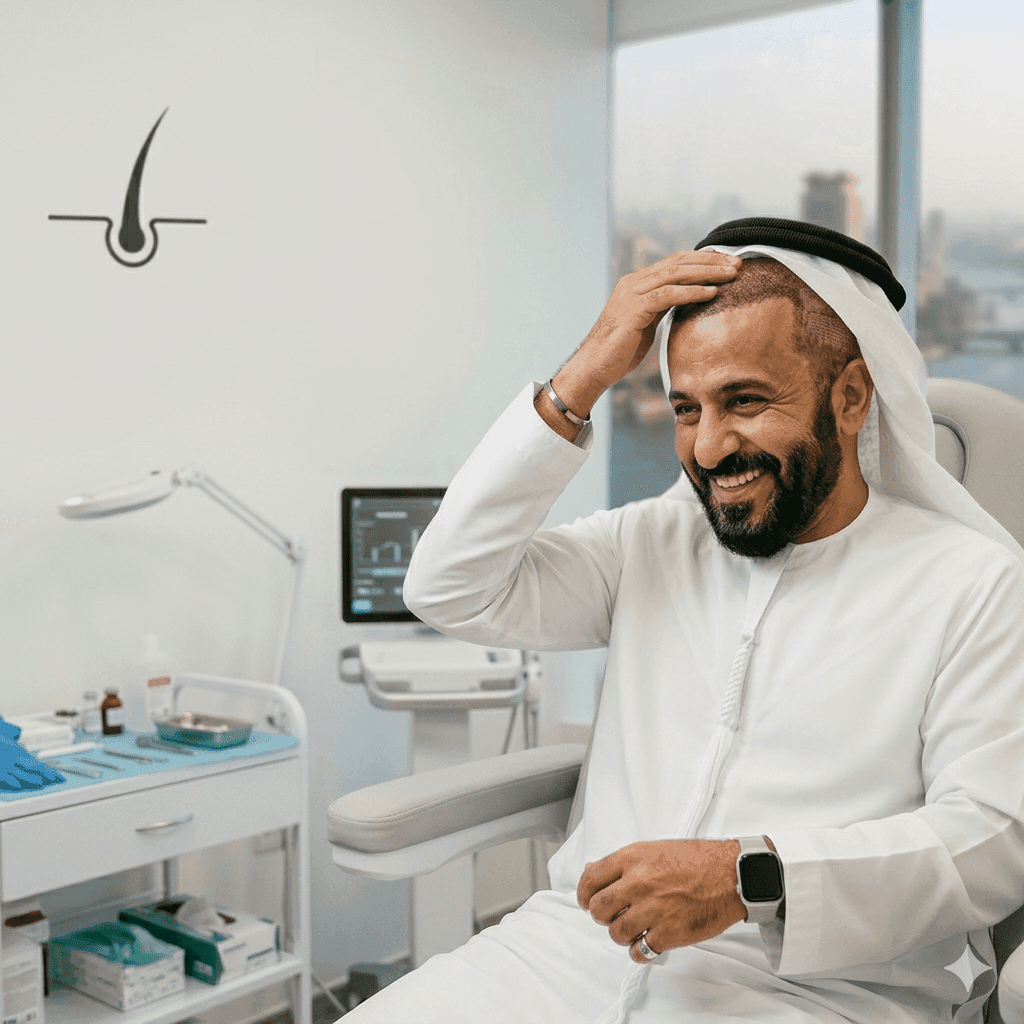
Hair Transplant in Egypt: FUE, DHI, Cost & the Turkey Alternative
A hair transplant in Egypt is one of the most searched medical trips for men from the UK, Ireland, Germany and across Europe and North America. The searcher is usually someone who has watched a hairline recede for years and wants a permanent fix without a long wait or a five-figure bill. Pyramedz coordinates the whole journey: the photo assessment, a doctor-led clinic, the hotel, transfers, the first medicated wash and follow-up through the growth phase. The American Academy of Dermatology notes that a transplant redistributes your own hair and that results build gradually over about a year, which sets a realistic frame for the sections below.
Overview
| Procedure | FUE, DHI or Sapphire FUE follicular unit transplant |
| Anaesthetic | Local anaesthetic |
| Procedure time | 4 to 8 hours depending on graft numbers |
| Total stay in Egypt | 2 to 4 days |
| Back to work | 2 to 5 days (some redness and tiny scabs for about a week) |
| Final result | 12 to 14 months |
Hair transplant in Egypt: what to know before you decide
The common misconception is that a transplant grows new hair. It does not. It moves follicles from a permanent donor zone at the back and sides of your head to the thinning area. That means the result is capped by how much donor hair you have, and pattern loss carries on in the hair that was never transplanted, so a good plan looks years ahead and often pairs surgery with medication.
How much does a hair transplant cost in Egypt?
There is no single price. The main factors are:
- The number of grafts needed (driven by the size of the area and your Norwood grade).
- The technique: FUE, DHI or Sapphire FUE.
- Whether one session is enough or the plan is staged over two.
- The surgeon's experience and whether a physician (not only technicians) performs the work.
- PRP sessions, medication and follow-up, if included.
For reference, private prices at home:
- UK private: around GBP 3,000 to 8,000 depending on graft numbers.
- United States: around USD 4,000 to 15,000.
- Canada: around CAD 5,000 to 18,000.
- Turkey is the best-known low-cost destination; Egypt offers a comparable price with a doctor-led model and a shorter, quieter trip for some patients.
Patients travelling to Egypt report a large saving against these figures, with the hotel and transfers in the package, and eligible cases can spread the cost through Tamara, subject to terms. A personalised quote follows your photo assessment. See the full cost guide and the cosmetic surgery packages from Pyramedz.
Hair transplant techniques
- FUE (Follicular Unit Extraction): individual follicular units are extracted from the donor area at the back of the head and implanted one by one. No linear scar, faster healing, the current standard for most patients.
- DHI (Direct Hair Implantation): a variation of FUE using an implanter pen that places grafts without pre-made channels. Can allow denser packing and precise angling, often used for the hairline and smaller areas.
- Sapphire FUE: FUE using sapphire blades to open the recipient sites, which can mean smaller incisions and quicker healing.
- FUT (strip method): a strip of scalp is removed and dissected into grafts, leaving a linear scar. Now used less often, mainly when very large graft numbers are needed in one session.
FUE vs DHI
| FUE | Recipient sites opened first, then grafts placed. Efficient for large areas and high graft counts. |
| DHI | Implanter pen places grafts directly, no pre-made channels. Denser packing and precise angling, often for the hairline. |
| Which is better | Neither universally. The surgeon chooses based on your pattern, density and the area treated. |
How many grafts will I need?
- The Norwood scale grades male pattern hair loss from I (minimal) to VII (extensive).
- A receding hairline (Norwood II to III) may need 1,500 to 2,500 grafts.
- A hairline plus mid-scalp (Norwood III to IV) often needs 2,500 to 4,000 grafts.
- Advanced loss (Norwood V to VI) may need 4,000 or more, sometimes over two sessions.
- Donor supply is finite, so a good surgeon plans for the long term, not just today.
Egypt versus Turkey for a hair transplant
Turkey performs the most hair transplants in the world and is usually the cheapest. Egypt sits at a similar price with a few differences some patients prefer: a physician plans and supervises the procedure rather than technicians working alone, coordination is in English, and the trip is shorter and less crowded. The clinic and the surgeon matter far more than the destination, so ask the same questions wherever you go: who performs the extraction and implantation, how many cases the doctor does, and what the aftercare protocol is.
Who is a good candidate for a hair transplant?
- Stable pattern hair loss (not sudden or patchy shedding, which needs a medical work-up first).
- A healthy donor area with enough density at the back and sides.
- Realistic expectations: a transplant redistributes hair, it does not create new density beyond the donor supply.
- Willing to continue medical treatment (such as finasteride or minoxidil) if advised, to protect non-transplanted hair.
Hair transplant growth timeline
| Days 1 to 3 | Swelling of the forehead is common. The recipient area has tiny scabs. You sleep semi-upright and follow a careful washing routine from around day 3. |
| Week 1 to 2 | Scabs clear with gentle washing; most patients fly home after 2 to 3 days. Redness fades over the second week. |
| Weeks 2 to 4 | Transplanted hairs shed. This is normal and expected, not a failure. |
| Months 4 to 14 | New growth begins around month 4, thickens through months 6 to 9, and the final result is seen at 12 to 14 months. |
Non-surgical options: do they work?
Finasteride and minoxidil can slow pattern loss and thicken existing hair, and low-level laser therapy and PRP are used as adjuncts. None of them regrow hair on a bald area, so they are best seen as ways to protect what you have, often alongside a transplant rather than instead of one.
Aftercare: do and don't
Do
- Sleep semi-upright for the first few nights to limit swelling.
- Follow the washing instructions precisely from day 3.
- Protect the scalp from direct sun for the first weeks.
- Keep taking any prescribed medication to protect existing hair.
- Be patient; the timeline to a full result is roughly a year.
Don't
- Touch, scratch or pick at the grafts in the first two weeks.
- Wear a tight hat or helmet until cleared.
- Smoke; nicotine reduces blood supply to the healing grafts.
- Do heavy exercise, swimming or saunas for the first 2 to 4 weeks.
- Judge the result before 12 months; shedding at week 2 to 4 is normal.
Why choose Pyramedz for your hair transplant trip in Egypt?
For patients travelling from the UK, EU and North America, Pyramedz provides:
- A written assessment from photos before you travel, with an honest graft estimate and whether you are a candidate.
- Coordination with a clinic where a doctor plans and supervises the procedure, not technicians alone.
- Airport pick-up, hotel near the clinic, and transfers.
- A written post-operative protocol in English, plus the first medicated wash done at the clinic.
- WhatsApp follow-up through the growth phase after you fly home.
- The option to spread the cost through Tamara for eligible cases, subject to terms.
Travel logistics are covered in the travel guide, and what recovery abroad is really like here.
Hair Transplant in Egypt: FAQs
How much does a hair transplant cost in Egypt compared to the UK, US and Canada?
There is no fixed price; it depends on the number of grafts and the technique (FUE, DHI, Sapphire FUE). Private prices at home are roughly GBP 3,000 to 8,000 in the UK, USD 4,000 to 15,000 in the US, and CAD 5,000 to 18,000 in Canada. Patients travelling to Egypt report a large saving, with the hotel and transfers included. A personalised quote follows your photo assessment.
Is Egypt a good alternative to Turkey for a hair transplant?
Turkey is the highest-volume destination and the cheapest on average. Egypt offers a similar price point, a doctor-led model where a physician plans and supervises the procedure, English-speaking coordination, and a shorter, less crowded trip. As with anywhere, the clinic and the surgeon matter more than the country.
What is the difference between FUE and DHI?
Both extract individual follicular units from the donor area. FUE opens the recipient sites first, then places grafts, and covers large areas efficiently. DHI uses an implanter pen to place grafts without pre-made channels, which can allow denser packing and precise angling, often for the hairline. Your surgeon recommends based on your pattern and density.
When will I see results?
Transplanted hairs shed around week two to four, which is normal. Real growth starts from month four, thickens through months six to nine, and the final result is seen at 12 to 14 months.
How long do I stay in Egypt?
Usually 2 to 4 days: one day for the procedure, one to two days for the first medicated wash and a check, then you fly home. Growth is monitored remotely afterwards.
Does a hair transplant leave scars?
FUE and DHI leave tiny dot scars across the donor area that are not visible once the hair grows to a short length. FUT leaves a single linear scar and is used less often now. Discuss which technique suits your hair length preference with the surgeon.
Do I still need to take medication after a transplant?
Often yes. A transplant restores hair in the treated area, but pattern hair loss continues in non-transplanted hair. Many surgeons advise continuing finasteride or minoxidil to protect existing hair; discuss the risks and benefits with the doctor.
Sources:
- International Society of Hair Restoration Surgery (ISHRS)
- American Academy of Dermatology (AAD) - Hair transplant
- NHS - Hair loss
- British Association of Dermatologists
This article is for general information and does not replace an in-person assessment. Sudden or patchy hair loss needs a medical work-up before any transplant is considered.
Related reading
Get an honest graft estimate
Send Pyramedz photos of your hairline and crown. A doctor gives you a realistic graft number, tells you whether one session is enough, and a transparent quote.
Request your assessment